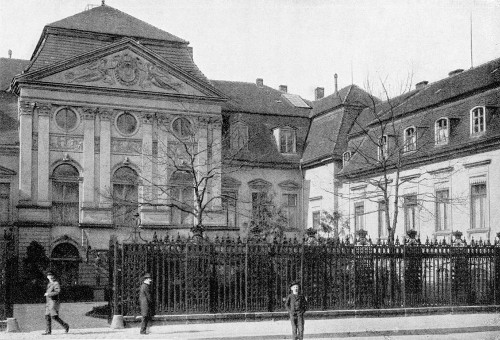
It was right here, at Wilhelmstraße 73–77 (facing west), that history was written. On January 30, 1933, Adolf Hitler entered the Reich Chancellery for the first time as Chancellor of the Reich—an apparently ordinary swearing-in ceremony, yet in truth, the beginning of a dictatorship.
That very evening, thousands marched through the city carrying torches. Hitler stood at the window—silent, observing. From this very spot, a regime was set in motion that would plunge Germany and the world into darkness.
The history of the Reich Chancellery dates back to the 19th century. At that time, an old urban palace served as the workplace for the Chancellors of the German Reich. Otto von Bismarck, too, worked here. Later, during the Weimar Republic, it was the place where governments came and went. Many Chancellors held office for only a few months. The political climate was turbulent; democracy was fragile.
But on January 30, 1933, everything changed. On that morning, Adolf Hitler entered the Reich Chancellery for the first time as the new Chancellor of the Reich. The elderly Reich President, Paul von Hindenburg, had appointed him. Many believed: This is merely a concession. They thought Hitler was loud and radical—but controllable. It was a grave error—one that would have dire consequences.
On the evening of that day, Berlin became a stage. Thousands of men from the SA and SS marched with torches through the darkened streets. The torchlight procession passed by the Reich Chancellery, where Hitler stood at the window, watching the spectacle unfold. Beside him stood politicians like Franz von Papen—men who believed they could control him.
In his diary, Joseph Goebbels wrote:
“The Führer stands at the window of the Reich Chancellery. A sea of torches. The new state is being born.”
The images circled the globe—serving as a symbol of the so-called “National Uprising.” Yet what appeared to be a ceremonial transfer of power was, in truth, the dawn of a dictatorship. Before long, fundamental rights are abolished, political opponents are arrested, and Parliament is stripped of its power.
Hitler revels in his new role—yet he finds the old Reich Chancellery too modest. Starting in 1938, he commissions the construction of a colossal new building—completed in just eleven months: the New Reich Chancellery on Voßstraße, located just nearby. Designed by Hitler’s favorite architect, Albert Speer, the structure was intended to project an aura of grandeur, strength, and order.
The New Reich Chancellery was immense: 421 meters long, featuring marble halls, opulent reception rooms, and a 400-square-meter office for Hitler. It was a structure that stood as a stone-clad demonstration of power. Yet, despite all its splendor, Hitler rarely used the building. He preferred to continue working in his old quarters—right up until the bitter end.
For with the advent of war, the Reich Chancellery also became the setting for the regime’s final days. In the garden of the New Reich Chancellery, Hitler ordered the construction of the Führerbunker. It was there—deep underground—that he took refuge as Berlin lay in ruins in April 1945. And it was there, on April 30, 1945, that he took his own life.
After the war, the verdict was clear: the Reich Chancellery buildings could not be allowed to remain standing as a monument to the dictatorship. The Soviet occupation forces ordered their demolition. By 1949, almost nothing remained. Today, scarcely a trace of either the old or the New Reich Chancellery can be seen.
Yet this site is steeped in history—history both momentous and horrific. It was here, on January 30, 1933, that the path toward an era of violence, war, and annihilation began.
Today, only commemorative plaques and exhibitions serve as reminders of the Reich Chancellery. But for those who stand here and look closely, the truth is palpable: even though the buildings themselves have vanished,
their history must never be forgotten.
-
Image: Reich Chancellor’s Palace, circa 1895. By unknown author – Greetings from Berlin and the Surrounding Area, published by Kunstanstalt W. Sommer, Berlin-Schöneberg, 1898. Public Domain. https://commons.wikimedia.org/w/index.php?curid=1025297
-
Image: By the Federal Archives (Bundesarchiv), Image 146-2006-0097 / Breuer, Kurt / CC-BY-SA 3.0. https://commons.wikimedia.org/w/index.php?curid=5419971
-
Image: By the Federal Archives (Bundesarchiv), Image 146-1980-008-09A / CC-BY-SA 3.0. https://commons.wikimedia.org/w/index.php?curid=5419159
-
Image: By Robert Sennecke – This image was made available to Wikimedia Commons by the German Federal Archives as part of a collaboration between the German Federal Archives and Wikimedia Germany. The German Federal Archives guarantees the authenticity of the image record solely through the originals (negatives and/or positives) or the digital copies of the originals held within its Digital Image Archive. Public Domain. https://commons.wikimedia.org/w/index.php?curid=5418919