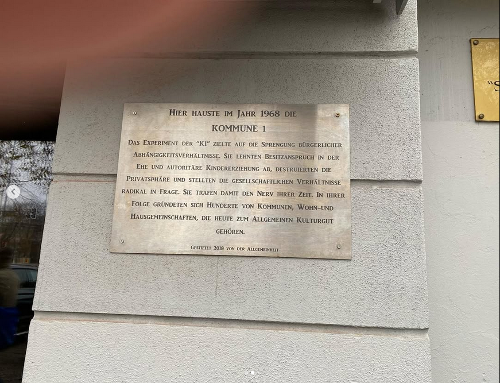
Imagine this: You are standing right here at Kaiser-Friedrich-Straße 54a, near Stuttgarter Platz, and the year is
1967. Inside, in a chaotic apartment within a historic building, lives the notorious Kommune
1—the terror of the bourgeoisie, the bête noire of the tabloid press, and the symbol of a rebellious youth.
Nine men and women make up the core group—names like Fritz Teufel, Rainer Langhans, and Dieter Kunzelmann. Their rules? None! Everyone does exactly as they please. Doors—even the one to the toilet—were taken off their hinges; privacy
simply did not exist. Personal possessions were frowned upon; free love was encouraged.
Before long, the commune begins making headlines: In late 1967, they plot the famous “Pudding Assassination” attempt against US Vice President Humphrey—using bags filled with flour and pudding mix. The plot is exposed, and the press pounces on the “horror communards.”
Then things turn serious: In protest against the Vietnam War, the commune calls for arson attacks on department stores. The student organization SDS expels them; Teufel and Langhans are indicted—and subsequently acquitted.
But as time goes on, the tone shifts. Interviews are paid for; media exposure becomes a business venture. Uschi Obermaier—Rainer Langhans’s future girlfriend—emerges as an “It Girl,” posing for tabloid magazines. The political agenda fades away, leaving behind nothing but parties, drugs, and nights of excess.
In late 1969, the situation escalates: Bikers storm the premises, trashing everything in sight. Kommune 1 dissolves.
What remains is a myth—and perhaps a blueprint for the many
shared apartments of today, which serve more as practical living arrangements than as revolutionary cells. But who knows? Perhaps a faint whiff of that wild era still drifts through the
street right here.
- Bild: eigenes Werk
- Bild: eigenes Werk
-
Bild: Von Stiftung Haus der Geschichte - 2001_03_0275.0565, CC BY-SA 2.0, https://commons.wikimedia.org/w/index.php?curid=44807264