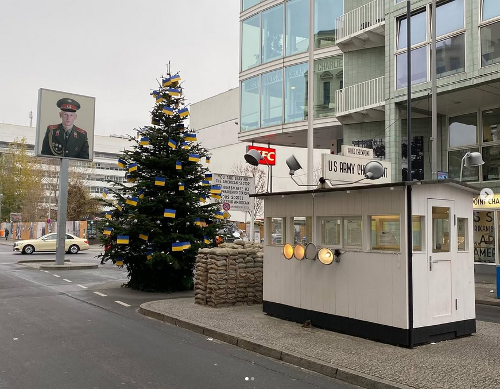
You are standing here at one of the most famous sites of the Cold War—Checkpoint Charlie. Its name? No coincidence. It was the third checkpoint established by the Western Allies—and in the international phonetic alphabet, “C” stands for “Charlie.”
Immediately after the construction of the Wall, this was a strictly guarded crossing—not for tourists, not for you, and not for most Berliners. Only Allied military personnel, diplomats, and select GDR officials were permitted to pass through.
Yet this unassuming spot nearly pushed the world to the brink of nuclear war. October 1961: Triggered by an unauthorized passport check by GDR border guards, American and Soviet tanks rolled up—right here, just a few meters apart. The soldiers sat inside their steel behemoths, weapons at the ready. For hours, they stared each other down, poised to pull the trigger.
The entire world held its breath.
From this very spot, too, GDR citizens attempted to flee to the West. Sometimes by cunning—sometimes by sheer force. The most spectacular escape? A 7.5-ton truck that simply smashed through the barriers. Some of these attempts ended fatally—
a memorial to the price of freedom.
On June 22, 1990—six months after the fall of the Wall—the checkpoint was dismantled. Ten years later, it was reconstructed on this very site—as a symbol, as a reminder, and as one of Berlin’s most-visited open-air museums. Image 1: Own work
Image 2: By Lyricmac at en.wikipedia, CC BY-SA 3.0, https://commons.wikimedia.org/w/index.php?curid=4479945
Image 3: By National Archives - http://nsarchive.chadwyck.com/bcphotox.htm, Public Domain, https://commons.wikimedia.org/w/index.php?curid=776863