Berlin—a hot summer day, July 20, 1944. In the corridors of the
Bendlerblock—right at the very center of power—a tense silence reigns. Here, within an unassuming office building, the threads of one of the most courageous acts of resistance against Hitler converged. A plan intended to change everything—
yet one that ended in tragic failure.
But let us begin at the beginning. The Bendlerblock was constructed in the early 20th century as an administrative building for the Imperial Navy. Later, during the era of National Socialism, the Wehrmacht took up residence there. Yet it was precisely in this place—right within the regime’s apparatus of power—that a quiet but resolute resistance began to take shape. Men in uniform, yet possessed of a conscience. Soldiers who were no longer willing to tolerate Hitler’s crimes.
One of them was Colonel Claus Schenk Graf von Stauffenberg. He was
intelligent, courageous—and, having sustained severe injuries in Africa, bore deep physical scars: missing a hand and an eye, yet he remained brimming with energy. Together with like-minded individuals, he hatched a plan. They called it “Operation Valkyrie.” Officially, it was an
emergency contingency plan for civil unrest within the Reich—but in truth, it was designed to facilitate a coup d’état following Hitler’s death. A new government, an end to the war,
a fresh start for Germany.
The co-conspirators were many: General Friedrich Olbricht, Ludwig Beck, Major General Henning von Tresckow, the young adjutant Werner von Haeften, and many others. Some wore uniforms; others hailed from the civilian resistance, such as Carl Goerdeler or members of the Kreisau Circle. All of them risked their lives—for the sake of freedom, for the sake of the future.
On July 20, Stauffenberg traveled to the “Wolf’s Lair”—Hitler’s
headquarters in East Prussia. Inside his briefcase: an explosive device. Under a pretext, he left the conference room—the bomb exploded, yet Hitler survived, suffering only minor injuries. A single small coincidence—a table leg that deflected the blast downward—tipped the scales of world history.
While Stauffenberg sat in the plane returning to Berlin, his co-conspirators at the Bendlerblock activated Operation Valkyrie. They dispatched orders, detained SS personnel, and placed calls to military command centers. For a few hours, it seemed as though the coup might succeed. But then came the news: Hitler is alive. And with it, the regime’s vengeance.
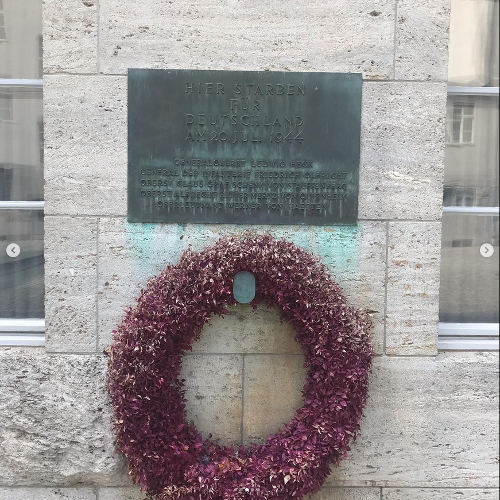
That evening, soldiers loyal to the regime stormed the Bendlerblock. General Fromm—himself implicated in the coup, but now desperate to save his own life—ordered the conspirators’ arrest. That very night, Stauffenberg, Haeften, Olbricht, and Mertz von Quirnheim were executed by firing squad in the building’s inner courtyard. Stauffenberg’s final words were: “Long live sacred Germany!”
What followed was a brutal wave of retribution. Over 200 people were executed, many families were arrested, and children were forcibly removed to state institutions. Yet the memory of their courage lives on to this day—right here, at the Bendlerblock.
Today, the inner courtyard is a place of remembrance. Where the resistance fighters were once executed, a statue now stands—a silent figure with bound hands, symbolizing the uprising of conscience. Housed within this same building is the German Resistance Memorial Center—a place for reflection and a solemn reminder.
And so, today, the Bendlerblock tells a story that goes beyond mere history. It speaks of courage in dark times, of conscience despite the uniform—and of the fact that freedom can never be taken for granted.
Please remain standing for just a moment longer—and let the spirit of this place sink in. Image 1: Own work
Image 2: Own work
Image 3: By Bundesarchiv, Image 146-1972-025-12 / CC-BY-SA 3.0, CC BY-SA 3.0 de, https://commons.wikimedia.org/w/index.php?curid=5482662
Image 4: By self – Photo (Permanent Exhibition “German Military History 1867 to the Present” at the Military Archive Department, Freiburg im Breisgau), Public Domain, https://commons.wikimedia.org/w/index.php?curid=43696055
Image 5: By Bundesarchiv, Image 146-1984-079-02 / CC-BY-SA 3.0, CC BY-SA 3.0 de, https://commons.wikimedia.org/w/index.php?curid=5871522