Imagine a vast hall, right in the heart of Berlin-Schöneberg. Ten thousand people could fit inside. Flags hung from the walls. In the center: an ice rink. Or a boxing ring. Or a stage.
The Berlin Sportpalast—a place of stark contrasts.
It was a place where people cheered, danced, argued, and shouted.
Major sporting tournaments were held here—but so, too, was one of the most dangerous speeches in German history.
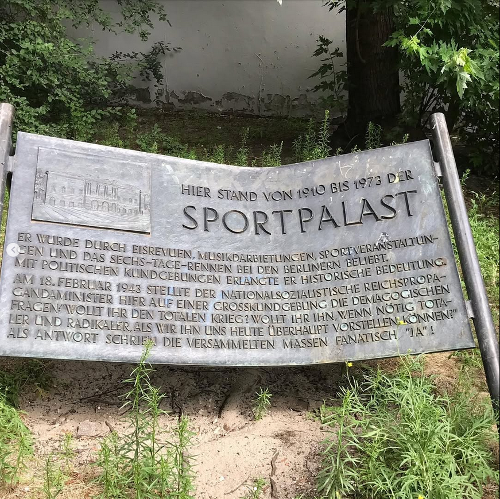
Today, at Potsdamer Straße 172 in Berlin, where an iron gate now stands amidst residential buildings, hardly a trace of the Sportpalast remains.
The Sportpalast opened in 1910. At the time, it was the largest indoor venue in Germany. For its inauguration, an orchestra performed Beethoven’s Ninth Symphony—it was intended to be a place of progress and joy. And so it was—at least at first.
In the 1920s, Berlin was booming. The Sportpalast was packed: with ice shows, bicycle races, equestrian tournaments, and massive boxing matches. During the famous Six-Day Races, spectators would often stay awake for days on end. The atmosphere was wild—almost like being at the circus. Concerts and revues were also held here; the Sportpalast was a venue for everyone.
However, during the Weimar era, the hall also took on a political dimension. Parties such as the SPD, KPD, and NSDAP used it as a venue for major speeches. And when the National Socialists seized power in 1933, the Sportpalast became a stage for propaganda.
On February 18, 1943, the moment arrived once again.
The war was raging, and the situation was dire. The Sixth Army had met its demise at Stalingrad. Many people had begun to doubt that victory was possible. Yet on that day, Joseph Goebbels—Hitler’s Minister of Propaganda—stepped onto the stage to deliver his most famous and most dangerous speech.
He spoke loudly, rapidly, and with intense passion. He played upon the emotions of the crowd. Time and again, he asked:
🗣
“Do you want total war?” The crowd screamed: “Yesss!”
But the audience was hand-picked, primed, and sworn to loyalty. It was not a spontaneous gathering, but a piece of theater—staged for the radio, for all of Germany. Millions listened in. And many believed what they heard.
Goebbels promised “final victory”—but in truth, he meant only: even more sacrifices, even more coercion, even more suffering. His words were intended to force an entire nation to hold out—no matter how hopeless the war had become.
This Sportpalast speech marked the pinnacle of Nazi propaganda. A moment in which words became weapons. And the Sportpalast—once a venue of jubilation—became a site of radicalization.
A year later, in January 1944, a British bombing raid destroyed large sections of the hall. After the war, it was simply rebuilt—without much grandeur, furnished only with the bare essentials.
But the Sportpalast lived on—this time as a stage for music. In the 1950s and 60s, stars such as Louis Armstrong, Ella Fitzgerald, Jimi Hendrix, and Pink Floyd performed there.
Bill Haley’s concert in 1958 ended in a massive brawl—dubbed the “Rock ’n’ Roll Battle of Berlin.” That, too, became part of the venue’s history.
Yet as the years passed, the hall grew old, expensive, and outdated. In 1973, it was demolished.
Standing in its place today is a large residential complex—the Pallasseum, colloquially known as the “Social Palace.”
Nothing remains of its former glory. And yet, the site endures in memory—as a symbol of the heights and abysses of German history.
The Sportpalast was more than just a hall. It was a mirror of its times. A place for sports and culture. For hope and fanaticism.
For music, dreams—and propaganda. A place that demonstrates just how much power words can hold. And how quickly they can transform an entire society.
Image 1: Original work
Image 2: Original work
Image 3: By Hermann Dernburg – https://architekturmuseum.ub.tu-berlin.de/P/229643.php, CC0, https://commons.wikimedia.org/w/index.php?curid=83687323
Image 4: By Bundesarchiv, Image 102-13120 / CC-BY-SA 3.0, CC BY-SA 3.0 de, https://commons.wikimedia.org/w/index.php?curid=5480878
Image 5: By Willy Pragher, CC BY 3.0, https://commons.wikimedia.org/w/index.php?curid=36689124
Image 6: By Bundesarchiv, Image 183-J05235 / Schwahn / CC-BY-SA 3.0, CC BY-SA 3.0 de, https://commons.wikimedia.org/w/index.php?curid=5434259