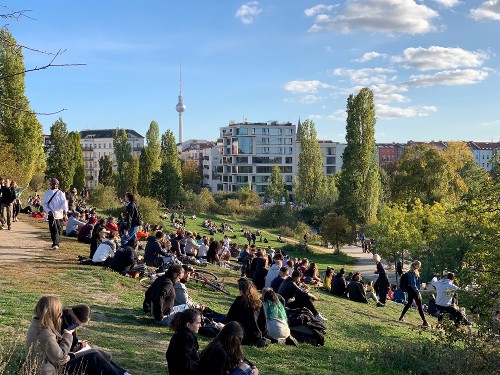
You stand here amidst the greenery, surrounded by colorful graffiti—and perhaps, especially on weekends, amidst music and flea market stalls. Where people now sing, dance, and celebrate, one of the world’s most heavily guarded borders once lay. Mauerpark in Berlin possesses a history that mirrors the city itself: full of ruptures, transformation—and new beginnings.
Over 200 years ago, this area was nothing special—merely fields on the outskirts of the city.
Before long, the military began using these vast open spaces as a parade ground. Soldiers marched and trained here, and in 1848, battles even raged across this very site during the revolution.
Later, toward the end of the 19th century, the area underwent a complete transformation. A major railway station was built: the Nordbahnhof (North Station), complete with tracks, freight sheds, and shunting yards. From here, trains rolled northward; coal was unloaded, and milk and potatoes were delivered. It was a loud, hectic place—one of Berlin’s most vital freight hubs.
During the heavy bombing raids on Berlin in the 1940s, the railway grounds suffered severe damage. Tracks and buildings lay in ruins, and many sheds burned to the ground. After the war, the site resembled a vast, scarred wasteland. Some sections were hastily rebuilt, but the station never regained its former significance.
Passenger service had been discontinued, leaving behind only a freight yard with long tracks, sheds, and warehouses. However, with the division of the city, the site became increasingly difficult to utilize. It lay precisely at the point where East met West.
Then came August 13, 1961. Overnight, the GDR erected the Berlin Wall. With it emerged the infamous “Death Strip”—and the grounds of what is now Mauerpark became part of it. Where trains once stood, barbed wire, patrol paths, and watchtowers now stretched out. This wide strip offered ideal conditions for border security. For East Berliners, this area was strictly off-limits; for West Berliners, it presented an eerie view from the outside. The railway tracks fell into disrepair, and the terrain remained a barren, ghostly wasteland.
Shortly before the end of the GDR—in 1988—the border in this section was shifted once again, by roughly 50 meters. A territorial exchange between East and West made the “Death Strip” even wider.
Then the Wall fell—and suddenly, open space existed there once more. A wound in the city. People wanted to reclaim it. Local residents and community initiatives began planting and landscaping the vacant land. The architect Gustav Lange drew up plans for a park. In 1994, it opened: the Mauerpark—a place of life situated exactly where the border had once signified death.
Today, that history can still be felt. At the edge of the park stands a section of the old Wall, painted with colorful graffiti. It serves as a reminder of how gray and desolate life here once was. Yet at the same time, it demonstrates just how profoundly Berlin can transform its spaces: from a railway station to a Death Strip, and finally to a meeting place for people from all over the world.
-
Bild: Von Traktorminze - Eigenes Werk, CC BY 3.0, https://commons.wikimedia.org/w/index.php?curid=124100325
-
Bild: Von Hans Rasp - Eigener Scan from negative, CC BY-SA 4.0, https://commons.wikimedia.org/w/index.php?curid=122376031
-
Bild: Von Gerd Danigel , ddr-fotograf.de, CC BY-SA 4.0, https://commons.wikimedia.org/w/index.php?curid=53638500