Berlin, Spring 1945. The city lies in ruins. The war is lost; the Red Army stands poised to storm the very heart of the Third Reich. And deep beneath the streets of Berlin—hidden beneath concrete, steel, and granite—Adolf Hitler entrenches himself in his final sanctuary: the Führerbunker. It is a place where the history of National Socialism meets a dark, claustrophobic end.
The so-called Führerbunker, situated just meters from the garden of the Reich Chancellery, was no monument to megalomania, but rather a stark concrete complex, buried two stories deep within the damp Berlin subsoil. Constructed in two phases—the Vorbunker (outer bunker) in 1936, and the Hauptbunker (main bunker) beginning in 1944—it originally served as a shelter against air raids. Yet, as the front lines closed in on Berlin in the spring of 1945, it became the nerve center of the collapsing regime.
With massive reinforced concrete walls up to four meters thick, airtight airlocks, its own water well, and a thundering diesel generator, the bunker was technically state-of-the-art—yet its atmosphere was anything but livable. The air was stifling, the roar of the generator omnipresent, and the perpetual scent of dampness and fear hung in every corner.
Here, Hitler spent his final weeks—accompanied by his longtime mistress, Eva Braun, who had moved into the bunker with him shortly before the war’s end. In adjoining rooms resided Propaganda Minister Joseph Goebbels, along with his wife, Magda, and their six children. Also living within this gloomy underworld were Martin Bormann, Hitler’s private secretary; the valet Heinz Linge; the adjutant Otto Günsche; the telephonist Rochus Misch; and Hitler’s secretaries, Traudl Junge and Gerda Christian.
The daily routine was monotonous: every day at 5:00 p.m., military situation briefings were held in the map room. The orders issuing from the bunker grew increasingly desperate—filled with delusions of divisions long lost and of phantom armies that were supposed to save Berlin.
On April 29, 1945, just hours before his death, Adolf Hitler married Eva Braun in a makeshift office within the bunker. That very same night, he dictated his political and private testaments, in which he designated Karl Dönitz as his successor. The following day, April 30, around 3:30 p.m., the dictator’s life came to an end: Eva Braun took a cyanide capsule; Hitler shot himself in his private quarters with a Walther pistol—presumably while simultaneously swallowing poison.
His body—along with that of his wife—was carried outside into the ruined garden of the Reich Chancellery, doused with gasoline, and burned, exactly as Hitler had explicitly ordered beforehand. The scene was witnessed by a few close confidants,
including Linge, Günsche, and Bormann. The remains—a skull fragment and dental fragments—were recovered by the Red Army. Years later, through
forensic analysis and dental records, they were conclusively identified as Hitler’s.
In October 1956, the Berlin District Court officially declared Hitler dead. All witness testimonies, investigations by Western and Soviet intelligence agencies, and forensic evidence
converge: Adolf Hitler died by suicide—deep beneath the rubble of a shattered city, in the heart of the collapsing “Third Reich.”
Today, nothing visible remains to mark the site of this chapter in world history. An unremarkable apartment block now stands on the grounds of the former Führerbunker. A small information plaque—scarcely noticed by passersby—marks the spot where one of the darkest abysses of German history once came to an end.
Yet the bunker remains—as a symbol. Not for power or escape, but for ruin, madness, and the bitter end of an ideology that cost millions their lives.
For your orientation:
Hitler’s Reich Chancellery was located within the area bounded by Wilhelmstraße, Voßstraße, Ebertstraße, and Behrenstraße in Berlin.
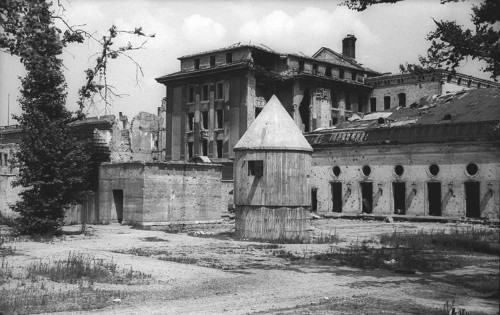
Image 1:
1947: Emergency exit (left) and a round, single-occupant bunker for the guard; on the right, the garden façade of the New Reich Chancellery. Source: Bundesarchiv, Image 183-V04744 / CC-BY-SA 3.0, CC BY-SA 3.0 de, https://commons.wikimedia.org/w/index.php?curid=5437633
Image 2:
The demolished Führerbunker, 1947. Source: Bundesarchiv, Image 183-M1204-319 / Donath, Otto / CC-BY-SA 3.0, CC BY-SA 3.0 de, https://commons.wikimedia.org/w/index.php?curid=5435292