Welcome to Berlin—a city whose history is as vibrant and dramatic as the River Spree that winds its way through the centuries. We stand here at the cradle of Berlin: St. Nicholas’ Church. It is the city’s symbolic birthplace, dating back nearly 800 years. This very spot was once inhabited by Slavic tribes—the Sprewane—who farmed the fields stretching along the banks of the Spree. The landscape was characterized by forests, meadows, and waterways. Then, in the 13th century, the first written records appeared: Cölln, situated on a small island in the Spree, in 1237; and Berlin, on the northern bank, in 1244. Two small trading settlements—initially separate, yet soon linked by the currents of trade and river traffic.
In 1307, the two towns joined forces to form a municipal union; by 1432, the dual city of Berlin-Cölln had emerged. Berlin gradually evolved into the heart of the Margraviate of Brandenburg following the Hohenzollerns’ rise to power in 1415. The city expanded, its defensive walls were extended, and the first public buildings began to take shape. Yet life was never easy; the rhythms of daily existence were defined by the recurring scourges of plague, famine, and political unrest.
With the advent of the Reformation in 1539, Berlin embraced Protestantism. Decades later, in 1613, Elector John Sigismund converted to Calvinism—and suddenly, two distinct faiths existed side by side: the Lutheranism of the general populace and the new Calvinist creed of the court. Tensions mounted, until, finally, the Thirty Years’ War engulfed the city. Berlin was plundered, the plague raged unchecked, and countless inhabitants perished. The population plummeted drastically, leaving entire districts lying in ruins.
Yet, in the aftermath of 1648, the work of reconstruction began under the leadership of the “Great Elector,” Frederick William. He issued a call to artisans, merchants, and the renowned Huguenots, inviting them to settle in his lands. They brought with them new knowledge, artisanal traditions, a burgeoning textile industry, and fresh cultural impulses that breathed new life into Berlin. The city begins to breathe again; streets are paved, and churches and administrative buildings are erected.
Then comes the 18th century: in 1701, Berlin becomes the capital of the Kingdom of Prussia. Frederick William I—the “Soldier King”—expands the city into a fortified administrative capital. His son, Frederick the Great, champions science, philosophy, and the arts. Under his reign, magnificent structures are built: the Forum Fridericianum, St. Hedwig’s Cathedral, and the Royal Porcelain Manufactory. Berlin becomes a center of the Enlightenment; philosophers, artists, and scientists flock to the city, and its streets fill with ideas and debates.
Yet this idyll is shattered. In 1806, Napoleon’s troops march into Berlin. The Prussian army suffers a crushing defeat, and the city is occupied. Berlin endures humiliation, looting, and political instability. But from this crisis, reform emerges: Prussia modernizes its administration, military, and education system. In 1810, Humboldt University is founded—a beacon of knowledge that will shape Berlin for generations to come.
From the mid-19th century onward, Berlin changes rapidly. Factories spring up overnight, railways connect the city to the rest of Europe, and tenement blocks proliferate to house the growing population. In 1871, Berlin becomes the capital of the German Empire. Grand boulevards such as “Unter den Linden” and the Kurfürstendamm take shape, while museums, theaters, and opera houses flourish. The city evolves into a world-class European metropolis—and the streams of people pouring in from the surrounding region fill it with life.
Following the First World War, Berlin serves as the capital of the Weimar Republic. In 1920, the Greater Berlin Act comes into force: Berlin expands to encompass over 3.8 million inhabitants and 20 districts—a pulsating, modern metropolis. The “Golden Twenties” are characterized by art, theater, film, cabaret, Bauhaus architecture, and scientific innovation. Yet the city is also fraught with tension: poverty, unemployment, and political violence are part of everyday life.
In 1933, the Nazis seize power. Berlin becomes a stronghold of the dictatorship. In 1936, the Olympic Games take place, staged as a propaganda spectacle. Jews—particularly from 1938 onwards—are systematically persecuted, deported, and murdered. Then comes the Second World War: bombs destroy entire districts, and the population suffers from hunger and hardship. In 1945, the war ends with the Battle of Berlin—the city lies in ruins, and hundreds of thousands of people are dead or displaced.
After 1945, the division begins. Berlin is divided into four sectors: the USA, Great Britain,
France, and the Soviet Union. West Berlin is isolated; East Berlin becomes the capital of the GDR.
In 1948, the Soviet Union blockades West Berlin—the airlift saves the city. In 1961, the
Berlin Wall is built, and families and friends are separated. The city becomes a symbol
of the Cold War.
Then, on November 9, 1989, the Wall falls. People climb over concrete blocks—weeping,
laughing, and embracing one another. Berlin becomes one again. In 1990, German unification is
completed, and Berlin becomes the capital of the reunified Germany. In 1991, the Bundestag votes for the
relocation of the government and parliament to Berlin; the move is completed in 1999.
Today, Berlin is a vibrant metropolis—a symbol of rise, destruction, division, and
rebirth. From a small twin town on the Spree to a metropolis of millions—every
street, every building tells stories of courage, resistance, and cultural diversity.
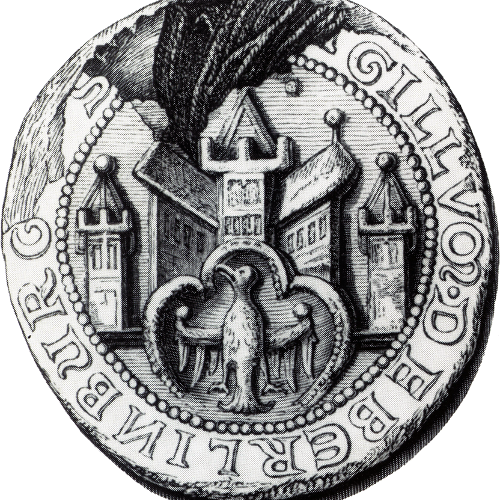
1st Image: Oldest seal of Berlin, 1253. By scan Jwnabd – Wolfgang Schneider: Berlin.
Gustav Kiepenheuer Verlag, Leipzig and Weimar 1983, p. 32. Public Domain,
https://commons.wikimedia.org/w/index.php?curid=187150
A Brief Excursion into Berlin's History
Aus dem Audiowalk Berlin Like You’ve Never Heard It Before – True Stories & Secrets

254:05 min Audio
8
Hör dir die Audiotour jetzt an, am besten in der Großansicht.
Oder nutze die App, um den Audiowalk vor Ort zu hören:


Andere Stationen in dieser Audiotour:
St. Nicholas' Church / St. Nicholas' Quarter (2:49 min) • Newspaper District (4:28 min) • Checkpoint Charlie (1:55 min) • Former Gestapo Headquarters (2:57 min) • Former Tempelhof Airport (3:46 min) • 7 Wannsee Conference (4:45 min) • Walther Rathenau Memorial (2:34 min) • Olympic Stadium / 1936 Olympic Games (5:36 min) • Commune 1 (2:27 min) • Benno Ohnesorg / Student Movement (2:16 min) • Rolf Eden (1:54 min) • Café Kranzler (2:08 min) • Kurfürstendamm (3:03 min) • Zoo Palace (3:47 min) • Kaiser Wilhelm Memorial Church (2:22 min) • Karl Liebknecht and Rosa Luxemburg (3:28 min) • Schöneberg Town Hall (2:33 min) • Former Sportpalast / Sportpalast Speech (5:12 min) • Bendlerblock/Stauffenberg assassination attempt (4:47 min) • Kroll Opera House / Enabling Act (3:09 min) • Reichstag Building (4:14 min) • Reichstag Fire (4:28 min) • Brandenburg Gate (2:52 min) • People's Court (3:08 min) • Potsdamer Place (2:58 min) • Former "Führerbunker" (5:06 min) • "Tresor" (Safe) (1:43 min) • Popular Uprising in the GDR (2:11 min) • Reich Chancellery / Hitler's Seizure of Power (5:11 min) • "Die weiße Maus" (The White Mouse) (2:57 min) • Friedrichstraße Station / "Tränenpalast" (Palace of Tears) (3:46 min) • Humboldt University (1:56 min) • Berlin Palace (5:04 min) • Red City Hall (2:30 min) • Alexanderplatz (2:30 min) • Otto Weidt's Workshop for the Blind / Anne Frank Center (2:05 min) • Hackesche Höfe (5:21 min) • Rosenthaler Platz (2:58 min) • St. Sophia's Church (3:03 min) • Sophie-Gips Courtyards (2:08 min) • Koppenplatz (3:16 min) • Clärchen's Dance Hall (3:54 min) • New Synagogue (2:19 min) • Berliner Ensemble (3:55 min) • Friedrichstadt-Palast (4:02 min) • Dorotheenstadt Cemetery (2:25 min) • Bloody May (2:18 min) • Humboldthain Flak Tower (5:17 min) • Chris Gueffroy and the Victims of the Wall (1:28 min) • Tunnel 57 / Egon Schultz (2:40 min) • AMIGA (1:37 min) • Bernauer Street (4:07 min) • Former Bornholmer Straße Border Crossing (3:26 min) • Friedrich-Ludwig-Jahn Sports Park (3:43 min) • Mauerpark (4:07 min) • Arkonaplatz (3:03 min) • Zion Church (3:44 min) • Prenzlauer Berg Fire Station (3:18 min) • Hirschhof (2:41 min) • Freya Klier (2:28 min) • Prater (2:28 min) • Oderberger Straße Municipal Baths (3:36 min) • Oderberger Street 2 (1:58 min) • Currywurst (2:16 min) • Konnopke's Snack Bar (2:43 min) • Gethsemane Church (2:09 min) • Museum in the Kulturbrauerei (1:06 min) • Kulturbrauerei (3:24 min) • Frannz-Club (2:31 min) • Husemann Street (1:58 min) • Jews' Passage (3:32 min) • Prenzlauer Berg Water Tower (2:37 min) • Rosa Luxemburg Square (4:34 min) • Mont Klamott (1:43 min) • Samaritan Church (2:23 min) • Former Stasi Headquarters / Stasi Museum (2:48 min) • Berlin-Karlshorst Museum / Unconditional Surrender (2:54 min) • East Side Gallery (2:59 min) • House Squatting in the 1980s (2:34 min)