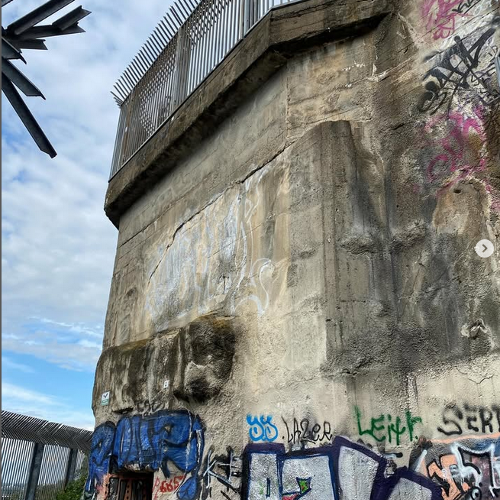
Towering before you rises a massive concrete colossus from dark times—the Humboldthain Flak Tower.
In 1941, Hitler ordered the construction of gigantic defensive towers to counter Allied bombers.
Within just a few months, a structure emerged in Humboldthain that seemed almost indestructible. The combat tower—before which we stand right now—stood over 40 meters tall, its walls composed of up to 3.5 meters of reinforced concrete. To its south stood the command tower, connected by a tunnel; this was the “brain” of the complex, while the G-Tower—the combat tower—provided the “muscle,” so to speak, directly fending off enemy projectiles.
On the roof of the G-Tower—the combat tower—four heavy 12.8-centimeter twin gun mounts thundered into action. Each shot tore a hole in the sky. These were supplemented by smaller guns designed to counter low-flying aircraft. From the command tower—the L-Tower—attacks were coordinated using radar and optical instruments. Together, the towers formed a perfect defensive pair, guarding the northern sector of Berlin—including railway stations, industrial facilities, and residential districts.
Yet, these towers were more than mere gun emplacements. Deep within their interiors lay air-raid shelters capable of accommodating up to 15,000 people. Families, children, the wounded—all huddled together here while, outside, sirens wailed and bombs rained down. For many, the tower became a symbol of safety—a fortress that, to all appearances, could never fall.
Berlin possessed a total of three Flak Tower pairs: Humboldthain in the north, Friedrichshain in the east, and Tiergarten in the west. Each pair consisted of a combat tower equipped with heavy artillery and a command tower dedicated to fire control. Together, they formed a network designed to defend the entire city. These complexes were gigantic: massive walls, thick ceilings, independent emergency power supplies, water mains, storerooms, infirmaries, and telephone exchanges. Each tower was a small, self-sufficient fortress block, capable of withstanding war and air raids. The towers always stood in pairs and were strategically positioned so that their guns provided mutual covering fire.
The complexes served not only for air defense; they acted simultaneously as command centers, air-raid shelters, and symbols of propaganda. From these sites, the Wehrmacht could monitor the skies, coordinate troop movements, and issue orders for the defense of Berlin.
In April 1945, as the Red Army encircled Berlin, the Humboldthain flak tower transformed into a final bastion of defense. Approximately 1,000 soldiers entrenched themselves here, firing upon the advancing troops. The command tower directed the guns, while the combat tower—the G-Tower—provided both shelter and firing positions. It was a desperate, deadly struggle. The massive walls withstood every assault; it was not until after the war that the Allies attempted to demolish sections of the structure—yet not everything could be destroyed. Many of the concrete blocks were simply too thick, and demolition blasts would have endangered nearby railway tracks or residential buildings. Consequently, the remnants of the structures remain standing to this day.
The command tower—the L-Tower—was demolished in 1947. Rubble and earth were piled atop its ruins, creating a sledding hill.
Only the southern section of the combat tower could be partially demolished. This section, too, was covered with rubble and earth, giving rise to the Humboldthöhe hill. Today, guides from “Berliner Unterwelten” lead tours through the inner corridors of the former
combat tower, showing the rooms where thousands sought shelter and sharing stories
of war, courage, and survival.
The Flak Tower in Humboldthain is, therefore, a place full of contrasts: a monument to war,
a shelter for people, and a battlefield during the final days of the conflict—yet today, it serves
simultaneously as a park, a lookout point, and a memorial. Standing here, one senses the immense power of
the structure, the terror of the nights of bombing, and—at the same time—the hope that
rises from the rubble.
Image 1: Own work
Image 2: Own work
Image 3: By Heinz Radtke – Family Archive Norbert Radtke, Public Domain, https://commons.wikimedia.org/w/index.php?curid=25543891
Image 4: Kasa Fue, CC BY-SA 4.0 https://creativecommons.org/licenses/by-sa/4.0, via Wikimedia Commons