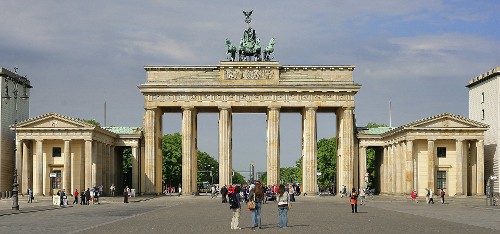
We are at arguably the most symbolic location in Berlin: the Brandenburg Gate! It is a place that sounds different every time—depending on where you look. Today, it is the classic spot for snapshots, strolling tourists, and New Year’s Eve celebrations—but the history behind it is truly fascinating.
Its origins date back to the late 18th century—specifically from 1788 to 1791. King Frederick William II commissioned Carl Gotthard Langhans to construct a monumental city gate in the Neoclassical style—intended as a symbol of peace. Not a massive triumphal arch like those in Rome, but something elegant—almost civilized.
In 1793, the Gate received its famous Quadriga: a goddess of victory riding a chariot drawn by four horses—a symbol of both peace and triumph. However, in 1806, Napoleon marched through, stole the Quadriga, and carted it off to Paris—a bitter humiliation for Prussia. Eight years later, following the Wars of Liberation, it returned amidst great jubilation—now adorned with new symbols, such as the Prussian eagle and the laurel wreath.
Throughout the 19th and 20th centuries, the Gate served as a stage for historic events: Imperial parades, Nazi rallies, and torchlight processions—all utilized it as a dramatic backdrop.
The Second World War inflicted severe damage: bullet holes, destroyed gatehouses, and a desecrated Quadriga. Yet, the Gate survived and was meticulously restored in the aftermath of the war.
Then came the Cold War: From 1961 onward, the Gate stood right in the middle of the Berlin Wall—heavily guarded, visible to only a few, and utterly inaccessible. It became a powerful symbol of division! It was also here that Ronald Reagan stood to deliver his famous speech: “Mr. Gorbachev, tear down this wall!” At the end of 1989, the dream came true: the Wall fell, and on December 22, the Gate was officially open once again—over 100,000 people gathered here to celebrate German reunification.
Today, the Gate is not merely a photogenic hotspot on Pariser Platz, but a symbol of unity, freedom, and peace—a living monument that recounts the highs and lows of German history.
Image Source (Image 1):
By Cezary p on the Polish Wikipedia, CC BY-SA 3.0, https://commons.wikimedia.org/w/index.php?curid=8300843
Image Source (Image 2):
By Daniel Chodowiecki – Daniel Chodowiecki, Public Domain, https://commons.wikimedia.org/w/index.php?curid=24027
Image Source (Image 3):
By Leopold Ahrendts – Own collection, Public Domain, https://commons.wikimedia.org/w/index.php?curid=54834012
Image Source (Image 4):
By Joergsam – Own work, CC BY-SA 3.0, https://commons.wikimedia.org/w/index.php?curid=20680945