Imagine standing on a perfectly ordinary street in Berlin—much like we are here on Bernauer Straße. Yet, in August 1961, this very street became the epicenter of one of the most dramatic episodes of Germany’s division. Overnight, a wall suddenly appeared here—a wall that separated neighbors, tore families apart, and plunged people into mortal terror. What made this street so unique was its location: the walls of the buildings belonged to East Berlin, but the sidewalks directly in front of them lay within West Berlin. This meant that if you lived on the first floor of one of these buildings, all you had to do was jump out the window—and you would land in the West. And that is exactly what many people did.
The GDR was determined to prevent this at all costs. In the very first days following the construction of the Wall, soldiers began bricking up windows, welding front doors shut, and forcibly removing people from their apartments—many were simply evicted. Later, the buildings themselves were demolished to ensure that no one could ever use them to escape again. In their place arose a rigid, intimidating system of walls, fences, watchtowers, and traps—collectively known as the border security system.
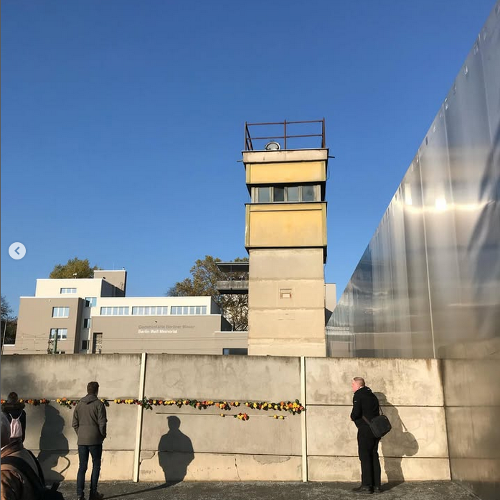
These fortifications were not merely a single wall; they constituted a veritable “Death Strip.” Immediately on the GDR side stood what was known as the “hinterland wall,” which served to separate everyday life from the actual border zone. Beyond that lay a cleared zone featuring an illuminated patrol road for GDR guards and a tripwire fence designed to trigger an alarm the moment anyone touched it. At the very center lay the Death Strip itself: a wide, barren expanse of sand where every single footprint was instantly visible. Trenches were dug to prevent anyone from attempting a vehicular breakout, and watchtowers manned by armed border guards stood sentinel everywhere. At the far end, toward the west, rose the famous concrete wall that can be seen in so many photographs today—the so-called border wall.
You can view parts of the former border fortifications right here, just a short distance away.
Yet, despite all these security measures, people did not give up. Along Bernauer Straße, some of the most courageous escapes in history took place. “Tunnel 57” became particularly famous. In 1964, a group of young West Berliners dug a tunnel beneath the Wall, running directly from a cellar on Bernauer Straße to a building in the East. In this way, 57 people were able to flee the GDR—at mortal risk. The tunnel was ultimately betrayed, and a GDR border guard lost his life in a shootout. Yet, the tunnel became a symbol of the desire for freedom shared by many East Germans.
After the fall of the Wall in 1989, Bernauer Straße was one of the first places where people streamed across—from East to West, finally free. Today, a memorial site commemorates this very location. Parts of the old border fortifications still stand there, and a “Chapel of Reconciliation” serves as a reminder of a church that once stood right in the middle of the “death strip” before being blown up.
The history of Bernauer Straße is the history of a divided city—but it is also a story of courage, freedom, and the power of solidarity.
Bernauer Street
Aus dem Audiowalk Berlin Like You’ve Never Heard It Before – True Stories & Secrets

254:05 min Audio
8
Hör dir die Audiotour jetzt an, am besten in der Großansicht.
Oder nutze die App, um den Audiowalk vor Ort zu hören:


Andere Stationen in dieser Audiotour:
A Brief Excursion into Berlin's History (7:59 min) • St. Nicholas' Church / St. Nicholas' Quarter (2:49 min) • Newspaper District (4:28 min) • Checkpoint Charlie (1:55 min) • Former Gestapo Headquarters (2:57 min) • Former Tempelhof Airport (3:46 min) • 7 Wannsee Conference (4:45 min) • Walther Rathenau Memorial (2:34 min) • Olympic Stadium / 1936 Olympic Games (5:36 min) • Commune 1 (2:27 min) • Benno Ohnesorg / Student Movement (2:16 min) • Rolf Eden (1:54 min) • Café Kranzler (2:08 min) • Kurfürstendamm (3:03 min) • Zoo Palace (3:47 min) • Kaiser Wilhelm Memorial Church (2:22 min) • Karl Liebknecht and Rosa Luxemburg (3:28 min) • Schöneberg Town Hall (2:33 min) • Former Sportpalast / Sportpalast Speech (5:12 min) • Bendlerblock/Stauffenberg assassination attempt (4:47 min) • Kroll Opera House / Enabling Act (3:09 min) • Reichstag Building (4:14 min) • Reichstag Fire (4:28 min) • Brandenburg Gate (2:52 min) • People's Court (3:08 min) • Potsdamer Place (2:58 min) • Former "Führerbunker" (5:06 min) • "Tresor" (Safe) (1:43 min) • Popular Uprising in the GDR (2:11 min) • Reich Chancellery / Hitler's Seizure of Power (5:11 min) • "Die weiße Maus" (The White Mouse) (2:57 min) • Friedrichstraße Station / "Tränenpalast" (Palace of Tears) (3:46 min) • Humboldt University (1:56 min) • Berlin Palace (5:04 min) • Red City Hall (2:30 min) • Alexanderplatz (2:30 min) • Otto Weidt's Workshop for the Blind / Anne Frank Center (2:05 min) • Hackesche Höfe (5:21 min) • Rosenthaler Platz (2:58 min) • St. Sophia's Church (3:03 min) • Sophie-Gips Courtyards (2:08 min) • Koppenplatz (3:16 min) • Clärchen's Dance Hall (3:54 min) • New Synagogue (2:19 min) • Berliner Ensemble (3:55 min) • Friedrichstadt-Palast (4:02 min) • Dorotheenstadt Cemetery (2:25 min) • Bloody May (2:18 min) • Humboldthain Flak Tower (5:17 min) • Chris Gueffroy and the Victims of the Wall (1:28 min) • Tunnel 57 / Egon Schultz (2:40 min) • AMIGA (1:37 min) • Former Bornholmer Straße Border Crossing (3:26 min) • Friedrich-Ludwig-Jahn Sports Park (3:43 min) • Mauerpark (4:07 min) • Arkonaplatz (3:03 min) • Zion Church (3:44 min) • Prenzlauer Berg Fire Station (3:18 min) • Hirschhof (2:41 min) • Freya Klier (2:28 min) • Prater (2:28 min) • Oderberger Straße Municipal Baths (3:36 min) • Oderberger Street 2 (1:58 min) • Currywurst (2:16 min) • Konnopke's Snack Bar (2:43 min) • Gethsemane Church (2:09 min) • Museum in the Kulturbrauerei (1:06 min) • Kulturbrauerei (3:24 min) • Frannz-Club (2:31 min) • Husemann Street (1:58 min) • Jews' Passage (3:32 min) • Prenzlauer Berg Water Tower (2:37 min) • Rosa Luxemburg Square (4:34 min) • Mont Klamott (1:43 min) • Samaritan Church (2:23 min) • Former Stasi Headquarters / Stasi Museum (2:48 min) • Berlin-Karlshorst Museum / Unconditional Surrender (2:54 min) • East Side Gallery (2:59 min) • House Squatting in the 1980s (2:34 min)