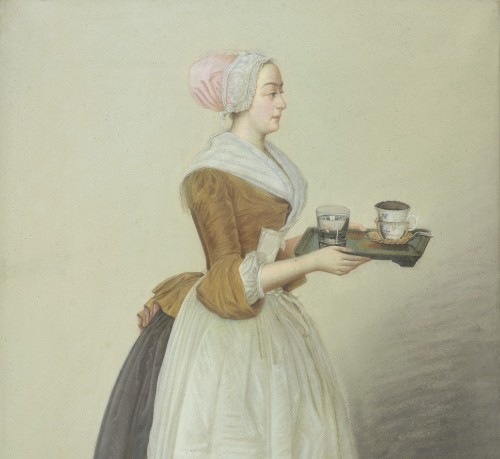
The cacao plant was cultivated along the Gulf of Mexico for thousands of years by the Olmec, Maya and Aztec peoples for food and religious ceremonies. Cocoa beans reached Europe in the course of Spanish colonial expansion. Europeans adapted the bitter drink they made to their taste by adding cane sugar, cinnamon and vanilla. From the 17th century onwards, it spread as an exclusive status symbol at aristocratic courts and among members of the Church. Pharmacies recommended it as a strengthening remedy.
Rising demand led to a massive expansion in production in the Atlantic region, where Spanish colonial rulers enslaved the Indigenous peoples of Central and South America and used them for plantation labour. By the end of the 17th century, through exploitation and imported epidemics, population numbers had been reduced by around 90 per cent. To make up for these “losses”, the colonial powers increasingly turned to enslaved African people. Spain’s cocoa monopoly collapsed when the Netherlands established its own trade routes from 1620 onwards, becoming the leading European importer of cocoa. Eventually, cultivation spread as far as Asia.
As a result of technological innovation during the 19th century, cocoa became a consumer good. Coenraad Johannes van Houten (1801–1887) invented a hydraulic press for producing inexpensive cocoa powder in 1828. It separated cocoa butter from cocoa mass. Daniel Peter (1836–1919) produced the first milk chocolate in 1875. He did this using milk powder, which had been developed in 1867 by Henri Nestlé (1814–1890.) Rodolphe Lindt (1855–1909) gave chocolate its characteristic delicate melt through a process known as conching in 1879. By the outbreak of the First World War, chocolate had gradually also become affordable for the working classes.